How High-Performance Fume Hoods Improve Lab Safety
How High-Performance Fume Hoods Improve Lab Safety
Quick Summary
High performance fume hoods use an aerodynamic entry, an airfoil sill, engineered rear baffles and a refined sash to keep airflow smooth across the hood face. That smoother flow may let a hood maintain containment at lower face velocities, reducing turbulence and exposure risk. Verified containment in the installed room, not the label alone, decides whether a hood performs.
Containment failures at a chemical fume hood rarely start with the exhaust fan. They usually begin at the hood face, where air rolls around square edges and carries vapors back toward the user. Well-designed high performance fume hoods are built to address that problem.
For lab directors and EHS managers, the real test is whether a hood holds its airflow pattern as people walk past and doors open. That starts with the hood's shape.
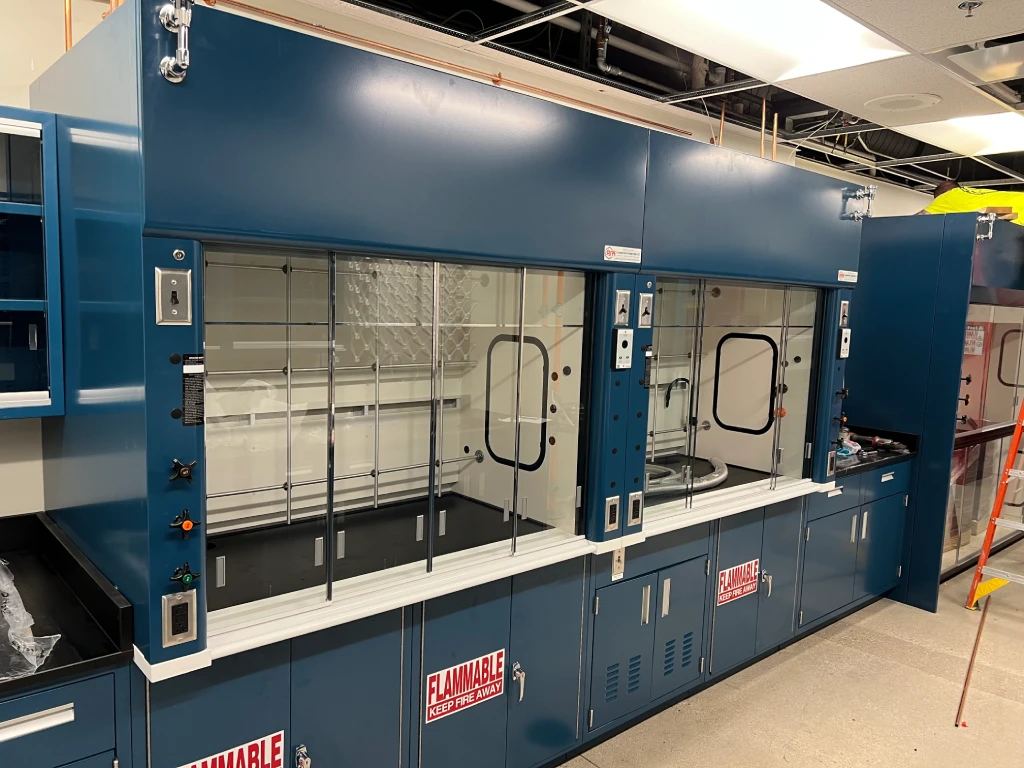
What Makes High Performance Fume Hoods Different?
Where a conventional hood often relies on air volume to overcome turbulence, a high-performance design works to prevent it through four features:
- Aerodynamic entry: Rounded corners and contoured side posts guide air in without forming eddies.
- Airfoil sill: A shaped sill sweeps air across the work surface, which can keep vapors from collecting near the opening.
- Engineered rear baffles: Slotted baffles spread exhaust across the back of the chamber so air leaves evenly.
- Sash design: A full-view sash, a lower safety bar and a cord pass-through let the sash close fully.
How Lower Face Velocity Can Still Support Containment
Higher face velocity does not automatically mean better protection, since excess velocity can create turbulence around the user. Conventional hoods are commonly set near 100 feet per minute, while many high-performance models are designed to operate between 60 and 80 feet per minute.
Because airflow stays smoother at those velocities, a well-designed hood may maintain containment while reducing turbulence at the opening. Our guide to fume hood face velocity requirements explains how labs set and verify those targets.
Energy savings can also follow. Exhausted air has already been heated or cooled, so containment at a lower velocity may reduce HVAC load.
Key Fume Hood Specifications to Review
Reviewing fume hood specifications helps match a hood to the process and the building's exhaust capacity. PSA's high-performance range runs from the 48-inch HP-604 at 380 CFM to the 96-inch HP-608 at 860 CFM. Compare these items:
- Width and sash opening for the equipment
- Exhaust collar size, required CFM and static pressure
- Liner material, lighting, double-wall construction and a UL 1805 listing
Why Proper Chemical Fume Hood Use Still Matters
Even a well-engineered aerodynamic design may not offset poor chemical fume hood use. Users should work at least six inches behind the sash plane, keep the sash at its designated height and move slowly at the face.
Additionally, large apparatus should sit on blocks so air can pass beneath it. See our fume hood safety best practices for more detail.
Testing and Certifying High Performance Fume Hoods
Factory results may not match performance in the finished room. The ANSI/ASHRAE 110 method evaluates face velocity, smoke visualization and tracer gas containment, using a mannequin to represent the user.
At PSA Laboratory Furniture, we provide fume hood testing and certification through examiners accredited by NSF International. Retesting after changes to the room's supply or exhaust can help confirm a hood still performs as designed.
A Simple Tip Before You Specify a Hood
Start with the room, not the catalog. Map the diffusers, doors and traffic paths near the planned location, then compare them against our high-performance fume hood models.
At PSA Laboratory Furniture, we help labs select, install and certify fume hoods suited to their processes and rooms. Request a quote for your next lab hood project, and get in touch with us to learn more today.
Frequently Asked Questions About High Performance Fume Hoods
A fume hood captures hazardous vapors, gases and fine particulates at the source and exhausts them away from the user's breathing zone. Protection depends on the hood, the exhaust system and the room working together, so lab managers can treat each hood as one part of the building's wider ventilation system.